The So What…

Insight is nothing without Action

  • Data is often treated like truth. Cold. Hard. Objective. For some its the holy grail and a hammer to beat you with. But here’s the catch: data doesn’t speak by itself — people interpret it.
    And depending on who is doing the interpreting, the story that data tells can look wildly different.

    Hand the same data set to a data analyst and a brand strategist, and you’ll get two very different takeaways. Both are valid. But they’re generally not the same. And that matters.


    👓 The Analyst’s View: What Does the Data Say?

    A good data analyst deals in clarity. In logic and in proof.
    Their goal is to report on what’s happening, based on the numbers in front of them. Unlike strategists, they don’t even really need to know the context to the data, as their job is to tell us what it says.

    The approach is typically:

    • What can be measured?
    • What patterns are emerging?
    • What’s performing well or underperforming?

    This kind of interpretation is essential — it keeps businesses honest, rooted in evidence. It powers dashboards, informs KPIs, and ensures we’re not leading the witness or picking and choosing the positive narrative.

    But by nature, this view is often binary. Fact-based. Less concerned with why something is happening — and more focused on what the numbers confirm.


    🧠 The Strategist’s Lens: What Might the Data Mean?

    A strategist or behavioural economist looks at the same dataset and starts turning it upside down.
    Not just what the numbers say — but what they don’t. What might sit behind them. What human behaviour, bias, context, or contradiction could be distorting the story.

    This mindset introduces:

    • Questioning of stated preferences vs revealed behaviour
    • Interpretation through cultural, psychological, or emotional frames
    • Curiosity around missing data or what wasn’t measured at all

    It’s less about reporting and more about interrogating. And yes this is where the tension often lies. Where a data analyst might say, “The campaign had low engagement,” a strategist might ask, “Were we even engaging the right people, in the right way, with the right context?”

    In that sense, strategy often lives in the grey. It searches for tension, nuance, and contradiction — not just patterns. But can also be perceived as trying to ‘spin’ a bad result or a better narrative.


    🔄 So, who’s right?

    They both are — but critically, not in silo.

    And that’s where multi-disciplinary teams and thinking becomes powerful.
    The best insights don’t come from one lens. They come from the collision between fact, context, psychology, culture, and sometimes — uncomfortable truth and ambiguity.


    The So What?

    The next time you’re handed a report or data deck, ask not just “What does this say?” — but also:

    “Who’s interpreting it? From what angle? And what might we be missing?”

    Because when you only rely on one lens, you risk oversimplifying the story.
    But when you blend analytical rigour with strategic empathy, you start to uncover not just what’s happening — but why it happened, how to respond, and where the next big step should go.


    Let’s Talk Strategy →


  • If there is a document that is almost guaranteed to cause tension within both client and agency teams its got to be “the brief”. If you’re not trying to seek out its existence, then you’re arguing over what should and shouldn’t be included. Is it too long, not long enough, have you tried to be too ‘creative’ in writing it and where oh where are the KPIs?!

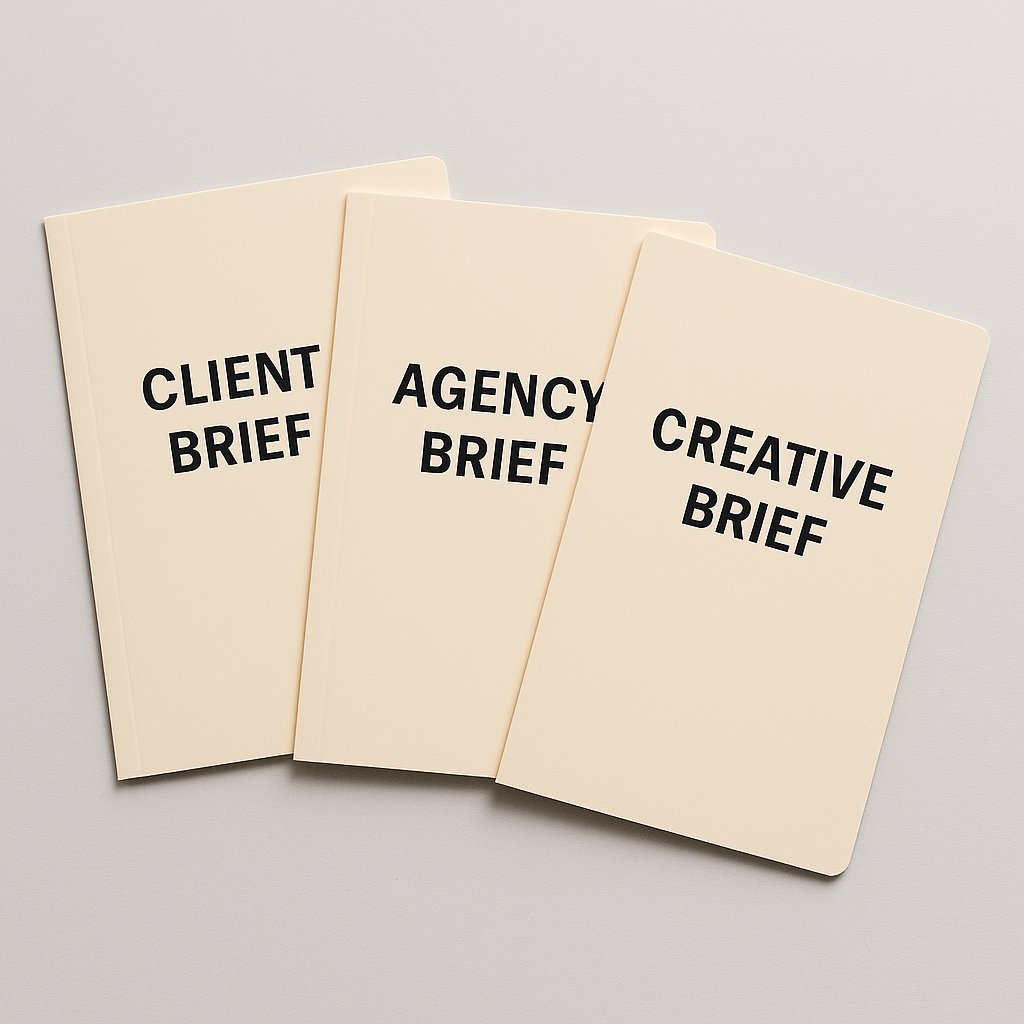
    In fact, if you ask ten people what they see as “the brief”, you’ll get ten different answers — a strategic wild west of formats, expectations, and opinions. But most of the tension comes down to one basic misunderstanding: ‘The brief’ isn’t one thing. And that’s OK.

    So let’s break it down.


    🧠 The Client Brief (AKA: The Business Brief)

    This is where it starts. Often written by commercial marketing or brand teams, the client brief sets out the business problem that needs solving. Think of it as the why — the commercial context, the customer challenge, the internal ambition. It doesn’t need to be sexy. But it does need to be clear.

    Done well, the client brief defines:

    • The business or brand objective
    • The challenge or opportunity
    • The key propositions
    • The target audience (from a customer & commercial lens)
    • Success metrics (yes, real ones)

    Importantly: This brief isn’t here to inspire the creative team. It’s here to give strategic direction and align stakeholders before anything goes out the door. That’s why creative teams get upset when their brief is a copy and paste of the client brief, it is not fit for purpose for the creative team.


    🎯 The Agency Brief

    This is the translation point — where business context is turned into creative opportunity.

    The agency brief (often led by planners or strategists) is designed to sharpen and reframe the client’s ask into something more pointed, relevant, and audience-led. It’s where layers get added — insights, behaviour, cultural context — to make sure the creative work has something to grab hold of.

    It’s also where the challenge gets rearticulated in a way the agency team can believe in. Not just “drive X% growth,” but “reclaim emotional relevance” or “be the first brand that talks about this in that way.”

    The best agency briefs:

    • Reframe the challenge in a human way
    • Deliver a sharp, single-minded proposition
    • Inspire collaboration across planning, creative, media and beyond

    Top Tip: If you don’t already, see this brief as the first point of collaboration between client and agency teams. Write and craft it together so that you have a shared responsibility for the ask and what success will look like.


    🎨 The Creative Brief

    This is where the magic starts. Built off the agency brief, the creative brief has one goal: to spark ideas.

    It still needs to be grounded in strategy, but it should now be distilled — tighter, more emotional, more provocative. The best ones have a clear proposition (a rallying cry, a strategic dare) and enough context to steer but not stifle.

    The creative brief includes:

    • The ultimate objective – What do we need to do
    • A motivating human truth or insight
    • The single most important thing to communicate
    • Tone of voice, mandatories, channels — and creative springboards

    Importantly, this brief isn’t about repeating the business ask. It’s about finding an inspiring way to communicate the key information that lets the team explore, play, and push ideas that will ultimately achieve the big objective.


    So… why do these differences matter?

    Because too often, we judge a brief by what it’s not.

    Planners get frustrated with vague client briefs.
    Clients get overwhelmed by strategic agency documents.
    Creatives roll their eyes at briefs that read like business plans.

    But each brief serves its own purpose — and each one is crucial at the stage it’s in.


    The So What?

    When you understand the real differences between the client brief, the agency brief, and the creative brief — and the unique role each one plays — you stop wasting time trying to turn one into the other.

    You stop chasing the mythical “perfect” brief, and start collaborating on the right brief for the right moment. And ultimately that’s where better work starts.


    Let’s Talk Strategy →


  • Strategy is everywhere. But too often, it stops short.

    A great insight, a sharp headline, a deck full of charts — and then?

    Insight without impact is just noise.
    The So What exists to close that gap. To ask the essential question:
    So what?

    This isn’t about surface-level observations or feel-good creative.
    It’s about clarity. Relevance. Action.

    Asking yourself ‘So What?’ is for those who don’t just want to know what’s happening — but need to understand why it matters and what to do next.

    This is where marketing becomes momentum.
    Where smart thinking meets sharp execution.
    And where strategy earns its seat at the table.

    Because real strategy doesn’t end with a slide — it ends with results.


    Let’s Talk Strategy →