Why sports fandom offers a different way to think about brand love, loyalty and belonging.

Image credit: Adam Rosenbaum Source: Website
Note: The below article is a thought piece based on research collated on the subject of fandom and includes 5 lessons brands can learn from this research. All sources are listed and linked at the end of the article.
There is something pretty special about being a real sports fan.
Whether you are born with your team pre-determined or you build a love for your side later in life, true fans are there with their team through thick and thin.
You could watch them lose six games in a row, have a manager that makes inexplicable decisions, gain new owners that do nothing but disappoint you. And yet whilst it might make you furious, you keep turning up, week in week out, because you’re a fan right?
Now imagine if that was a product delivering six consecutive disappointing experiences. Would we still expect their customers to keep showing up? I highly doubt it.
This is what is so alluring about fandom for marketers: True fans never leave.
But what is it about sports fandom that drives such resilience? And can a brand ever have the same effect?
In my career I have worked with businesses obsessed with fandom.
At Sky Bet we built an entire platform around it called ‘For the Fans’. But rather than trying to turn our betting customers into super fans, we were using our deep knowledge of sports fandom and the rituals that go with it to demonstrate to our customers that we ‘get them’. As people and as fans. In most cases this strategy was great for us. We moved the dial on salience, distinctiveness and even trust. But we also almost undid all our hard work in an instant by placing a 48 sheet saying ‘If I wasn’t a fan, I wouldn’t hate all things red’ outside Old Trafford. Check your media plans folks!
So why look at fandom today?
Well my feed has been inundated recently with the topic of ‘Brand love’ and in some cases specifically ‘Brand Fandom’. And it sparked a question in me I wanted to dig into.
Are brand fans actually fans?
Or do they just like your product a lot.
We marketers love talking about fans – This is not new news. And we do a lot to prove that our brands have them. We track community size, engagement and advocacy. We encourage influencers within our community to create content for us and congratulate ourselves when that content sells. But are our customers buying from a brand they love, or a person they love?
And does talking about a product, repeatedly buying it and even recommending it to friends make you a fan? Or just a good customer?
One dimension of sports fandom demonstrated in research is a strong sense of loyalty to your side. As with the Sky example, because you like the reds, you instinctively dislike (or hate) the blues.
But this same rivalry rarely shows up for brands. The same study looked at self claimed ‘fans’ of sportswear brands such as Nike and Adidas. The sportswear fans also showed rivalry, but on average it was far less pronounced than among the sports supporters surveyed.
One of the most endearing observed behaviours of sports fandom, in particular football, is the sense of ‘we’ ness. When your team has a great day ‘We were amazing’ or ‘We put a great side out’.
But when Apple launches a disappointing new model no one says ‘We really let the side down’.
Even if Apple users are uniquely loyal to their products, just like a fan would be.
The little often overlooked word ‘we’ tells us something really important about fandom.
Sports supporters aren’t just invested in the clubs performance, they often experience its highs and lows as if they were their own.
What makes a fan?
One of the most useful ideas from identity research is that identification has three dimensions:
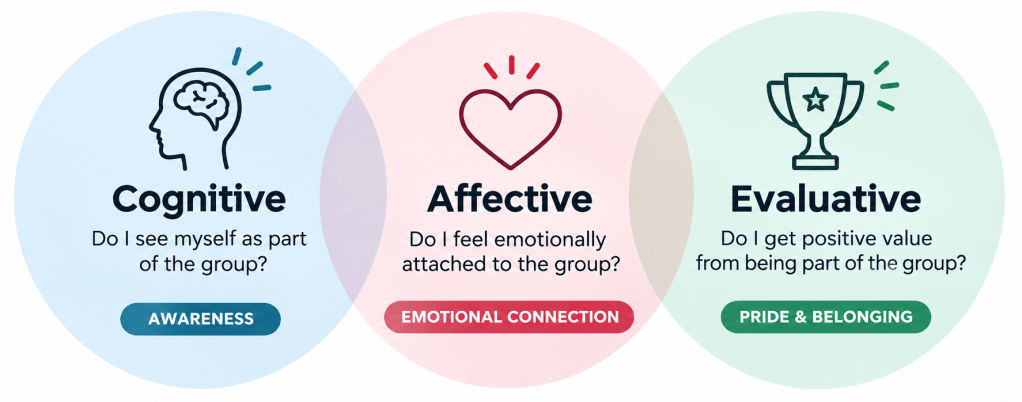
Which could give us a useful framework with which to start to measure whether we actually have a fan cohort. But there is a difference between fans of our brand (Fanship) and true Fandom.
Fanship describes an attachment to the object of my support – the team or product. The other (Fandom) describes a sense of belonging among the people who share it. And this difference is important. Research suggests that identifying with a team and identifying with its wider supporter community are distinct relationships, and that each can influence loyalty in different ways. Understanding both may be important if brands want to build relationships that endure.
The power in feeling that something is ours
The more I’ve explored the concept of fandom, the more I’ve become interested in the idea of psychological ownership. Football supporters often talk about our club, despite having no legal ownership of it. They feel that they are entitled to have an opinion on decisions made about it, they challenge decisions they believe threaten its identity and they protect its traditions. Fiercely.
Imagine how powerful (and potentially challenging) this would be for fans of a brand. Another study I looked at suggested that this sense of ownership is distinct from simply identifying with a team you like. It also suggested that genuine fandom is forged not just through affection but critically through participation, contribution to traditions and a feeling of shared ownership.
Going back to football. Think about what makes football culture so powerful.
The chants, the game day rituals, the friendships, the knowledge of which are the true supporters pubs, burger vans and super fans. The years of shared experiences of triumph and ‘do you remember when’.
The club doesn’t create these things. The supporters do.
And the research suggested that it was the participation in these supporter sanctioned rituals that strengthen identification over time. So perhaps fandom isn’t something a brand can create at all, its something the community creates for itself.
Can a commercial brand create the conditions for fandom to grow?
Contrary to what you might be thinking, if you’ve made it this far, I think they can.
However, it appears to be far more rare than we would like to believe. After reading all the reports, I was left with an overwhelming sense that this is an impossible task. So I started to look for examples that might prove me wrong.
And yes I started with the fairly obvious.
Apple. A brand that creates fiercely loyal customers. You don’t have to look far to see aspects of fandom in this case. The Apple vs Android rivalry. The clear examples of apple being part of someone’s identity – A source of inspiration for their ‘Behind the Mac – Greatness’ campaign.

But here’s where it falls down. Do I feel connected with another Apple customer in any way? No.
And honestly, if I had several terrible iphones that were never working would I continue to spend my £ on the next? Maybe, maybe not.
Then there is Guinness. A brand with clear rituals and culture. Symbolism around its pour and it is connection to the Rugby Union culture as ‘the’ drink on game day. But are people part of a Guinness community. Or is Guinness enhancing fandom of a sport itself?
The best example I can find to buck the trend is Harley-Davidson.

Harley owners are proud to identify as such. For some owners the relationship with their bike extends far beyond the product itself and includes riding groups, rituals, shared experiences and even a fierce rivalry against other brands/styles of bikes.
For some, being part of the Harley community becomes a lasting identity, part of your DNA and like football, is often something you share with, or at least try to, with family members and different generations. This is where fandom moves into belonging.
The commercial value of belonging
So if we have established that fandom is hard to create, harder to control and in reality, in the case of having a brilliant product that just works really well (like Apple), not always necessary, why would we even bother trying.
Well, we know that loyal customers are valuable. So, what if stronger fandom creates a different, supercharged version of loyalty? One rooted not just on satisfaction with a product or service but with identification, belonging and a sense of shared responsibility. That could be incredibly powerful.
Research into sports fandom examined how psychological ownership influences responses when brands/teams make mistakes. One particularly interesting finding is that it can create competing reactions too.
People more willing to be vocal/punishing when their team/brand has done something wrong but at the same time, more willing to encourage them to help them recover. That sense of ‘we are in it togetherness’ I mentioned earlier.
Think about that for a second. For some brands that could be game changing. Your most committed customers might be your harshest critics but they also might be the most invested to support or help you put it right. That could be a commercial advantage. Not just customers who buy more, create more, recommend more. But customers who’s relationship is strong enough to survive a disappointing experience.
Perhaps fandom doesn’t make people less critical when things go wrong. It makes them more invested in what happens next.
So what should brands actually do?
I think there are five key takeaways for marketers who want to build relationships that are deeper and more resilient than conventional brand loyalty would suggest.
1. Stop confusing engagement with fandom
Likes, shares, repeat purchases and recommendations are valuable behaviours. But they don’t equate to fandom.
If fandom matters, we need to understand and start to track the metrics that measure the underlying more valuable community driven relationships, not simply community activity we can observe.
2. Build identity not just preference
What does being associated with your brand say about the customer? What values, ambitions or experiences might they genuinely identify with as a result?
A brand doesn’t need to be part of someones identity to succeed. BUT if they aspire to create fandom, then becoming an identity marker should be a bigger goal than whether people liked their latest campaign.
3. Create opportunities for fans of your brand to belong to one another.
The strongest fan communities aren’t simply audiences gathered around something they all like. They are people that forge relationships with each other because of something they all like.
Brands will succeed in creating these communities if they can nail not just what makes customers want to engage with them but what might make customers engage with each other.
4. Give people meaningful influence
This might be the biggest lesson from sport so far. Supporters help create the culture at their clubs. They establish the rituals, they develop the traditions and they become the fiercely protective ones of brand assets and emblems.
So brands need to be willing to relinquish some control if fandom is the goal. That could mean inviting customers into decisions, enabling co-creation and genuinely listening more than you speak. Not tokenistic participation, but real opportunities to shape and protect something.
5. Measure the relationship you are trying to build
Whilst the research tells us that fandom should pay. The only way to know is to prove it. And not surprisingly, self selecting ‘I’m a fan’ doesn’t cut it.
We could start by asking customers if they see the brand as part of their identity (cognitive). If they feel emotionally attached to it or decisions made about it (affective). And if they are proud to be associated/seen with it (evaluative). We could even ask on what scale they feel connected to other owners/fans of the brand (community).
Then we should test whether those feelings predict stronger retention, advocacy, participation or resilience when things go wrong.
Because if the theory holds – they should.
The so what?
I don’t actually believe that every brand needs fans. Many brands will continue to thrive simply by offering brilliant products, in the right place at the right time.
But for brands where relationships and commercial value has to be built over time, (Financial services, B2B and SaaS, Mutuals and Co-operatives) I think sports fandom gives us an important lesson.
Building genuine fandom requires a different strategic approach. Less focus on attracting followers and managing audiences alone and more on creating belonging and empowering communities. It means being willing to listen, invite participation and give customers a genuine say in what the brand becomes.
The irony is that the more powerful a fandom becomes, the less you may be able to control it. But perhaps that’s where the value lies.
Because the secret to creating fans who never leave may not be getting people to love your brand more. It’s giving them something they feel belongs to them, something worth contributing to, and something they want to protect.
And that might be the most commercially valuable relationship a brand can build.


Leave a Reply